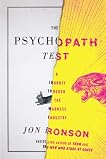
 The Psychopath Test: A Journey Through the Madness Industry by Jon Ronson
My rating: 4 of 5 stars
Despite a few glib errors - such as not differentiating between psychopathy and sociopathy - and attributing "[...] wanted to kill women because he thought looking into their eyes as they died would make him feel normal" to Ted Bundy, this book provides fascinating insight into what happens in the field, today.
For instance, Ronson visits Robert Hare, by many considered to be the father of modern-day views on psychopathy. Many criticize him for having conducted nearly all of his research for his psychopathy checklist - PCL-R, widely known as the most well-used checklist for professional psychologists to spot potential psychopaths - on prison inmates:
“I came to you,“ I said, “because of this guy called Tony. He's in Broadmoor. He says they're falsely accusing him of psychopathy and he hopes I'll do some campaigning journalism to support his release. And I do have warm feelings for Tony, I really do, but how do I know if he's a psychopath?“
Bob didn't seem to be listening. It was as if the crash had made him introspective. He said, almost to himself, “I should never have done all my research in prisons. I should have spent my time inside the Stock Exchange as well.“
I looked at Bob. “Really?“ I said. He nodded. “But surely stock-market psychopaths can't be as bad as serial-killer psychopaths,“ I said.
“Serial killers ruin families.“ Bob shrugged. “Corporate and political and religious psychopaths ruin economies. They ruin societies.“
Ronson consciously writes like a a literary Karl Pilkington, i.e. a buffoon who plods along and discovers major things along his way by mistake. Of course Ronson knows what he is doing, and he has probably taken his time in editing his book that way. To me it's funny as he keeps the tempo up, but it's also a tad to effect-seeking for me. For instance, from Ronson's meeting with Al Dunlap, a person who scored himself high on the most simplistic lay-person version of the PCL:
We had lunch before I left. Al seemed in surprisingly high spirits for a man who'd just been questioned on which psychopathic traits most applied to him. He had a little gold ax on his lapel. As we ate, he told me funny stories about firing people. Each was essentially the same: someone was lazy and he fired them with an amusing quip. For instance, one lazy Sunbeam executive mentioned to him that he'd just bought himself a fabulous sports car. “You may have a fancy sports car,“ Al replied, “but I'll tell you what you don't have. A job!“ Judy laughed at each of the anecdotes, though she had surely heard them many times, and I realized what a godsend to a corporation a man who enjoys firing people must be.
One of the key strengths of this book is Ronson's background as a journalist. He digs, digs and digs, tries to find something valuable and presents it affably as he goes from Gothenburg to England, from America to Canada, seeking psychopathy among the very rich, the very poor, the researchers themselves and the victims.
What I like the most of the book is Ronson's dissections of his own thoughts as he discovers the meaning of psychopathy beyond the tabloids, how he - having taken one of Robert Hare's courses - first feels like an empowered psychopath-spotter...
I wrote to him, fully expecting a refusal. Talking to me would, after all, have violated the terms of his release. Once the authorities found out, he could well have been arrested, deported back to Haiti, and executed. Prospective interviewees tend to turn me down for a lot less than that. Many decline my interview requests simply because they think I might portray them as a little crazy. Nonetheless, he cheerfully agreed to meet me. I didn't ask why because I was just glad to get the interview and“”if I'm honest“”I didn't really worry about what would happen to him as a result, which I suppose is a little Item 6: Lack of Remorse or Guilt, Item 7: Shallow Affect, and Item 8: Callous/Lack of Empathy, but he was a death-squad leader, so who cares?
...only to delve into self-examination as to how he is simply using the PCL-R to confirm his own, basic needs and desires, e.g. how he dislikes A. A. Gill, a critic known to dislike Ronson's work.
And then there are drugs...
Gary Maier“”the psychiatrist who invented the dream workshops and the chanting rituals at Oak Ridge and was eventually fired for giving LSD to twenty-six psychopaths simultaneously“”was recently invited for lunch by some drug company reps. He works at two maximum-security prisons in Madison, Wisconsin, now and his department had just made the decision to have nothing more to do with the drug companies. So a few of the reps invited him for lunch to find out why.
“It was two beautiful women and a pretty nice guy,“ Gary told me after the lunch was over.
“What did they say?“ I asked him.
“Well, if you look for me on the Internet, you'll find essays I've written about Indian effigy mounds,“ he replied. “They're my hobby. So the two beautiful women spent most of the lunch asking me about effigy mounds. They had me drawing pictures of effigies on the tablecloth.“
“And then what?“ I asked.
“Then they got down to it,“ he said. “Why wasn't I using their products? I said, “˜You guys are the enemy. You've hijacked the profession. You're only interested in selling your products, not in treating patients.' They all had a run at me. I held my ground. Then the bill came. We were ready to go. And then the more attractive of the two women said, “˜Oh! Would you like some Viagra samples?'“
Gary fell silent. Then he said, with some fury, “Like street pushers.“
...and the maybe-psychopaths...
“What will you do now?“ I asked.
“Maybe move to Belgium,“ he said. “There's this woman I fancy. But she's married. I'll have to get her divorced.“
“Well, you know what they say about psychopaths,“ I said.
“We're manipulative!“ said Tony.
...and perhaps the most interesting question of all: what of the DSM, the diagnostic manual most commonly used throughout the world for diagnosing mental disorders?
When Robert Spitzer stepped down as editor of DSM-III, his position was taken by a psychiatrist named Allen Frances. He continued the Spitzer tradition of welcoming as many new mental disorders, with their corresponding checklists, into the fold as he could. DSM-IV came in at 886 pages. Now, as he took a road trip from New York down to Florida, Dr. Frances told me over the phone he felt they'd made some terrible mistakes.
“It's very easy to set off a false epidemic in psychiatry,“ he said. “And we inadvertently contributed to three that are ongoing now.“
“Which are they?“ I asked.
“Autism, attention deficit, and childhood bipolar,“ he said.
“How did you do it?“ I asked.
“With autism it was mostly adding Asperger's, which was a much milder form,“ he said. “The rates of diagnosis of autistic disorder in children went from less than one in two thousand to more than one in one hundred. Many kids who would have been called eccentric, different, were suddenly labeled autistic.“
I remembered my drive to Coxsackie Correctional Facility, passing that billboard near Albany“”EVERY 20 SECONDS A CHILD IS DIAGNOSED WITH AUTISM. Some parents came to wrongly believe that this sudden, startling outbreak was linked to the MMR vaccine. Doctors like Andrew Wakefield and celebrities like Jenny McCarthy and Jim Carrey promoted the view. Parents stopped giving the vaccine to their children. Some caught measles and died. But this chaos, Allen Frances said, pales next to childhood bipolar.
“The way the diagnosis is being made in America was not something we intended,“ he said. “Kids with extreme irritability and moodiness and temper tantrums are being called bipolar. The drug companies and the advocacy groups have a tremendous influence in propagating the epidemic.“
...not to mention:
When I asked Robert Spitzer about the possibility that he'd inadvertently created a world in which some ordinary behaviors were being labeled mental disorders, he fell silent. I waited for him to answer. But the silence lasted three minutes. Finally he said, “I don't know.“
“Do you ever think about it?“ I asked him.
“I guess the answer is I don't really,“ he said.
“Maybe I should. But I don't like the idea of speculating how many of the DSM-III categories are describing normal behavior.“
“Why don't you like speculating on that?“ I asked.
“Because then I'd be speculating on how much of it is a mistake,“ he said. There was another long silence. “Some of it may be,“ he said.
And a very humane twist to this, from somebody preferring the term "sociopath" instead of "psychopath", according to Ronson:
“What if the wife of a psychopath reads this?“ I asked. “What should she do? Leave?“
“Yes,“ said Martha. “I would like to say leave. You're not going to hurt someone's feelings because there are no feelings to hurt.“ She paused. “Sociopaths love power. They love winning. If you take loving kindness out of the human brain, there's not much left except the will to win.“
“Which means you'll find a preponderance of them at the top of the tree?“ I said.
“Yes,“ she said. “The higher you go up the ladder, the greater the number of sociopaths you'll find there.“
“So the wars, the injustices, the exploitation, all of these things occur because of that tiny percent of the population up there who are mad in this certain way?“ I asked. It sounded like the ripple effect of Petter Nordlund's book, but on a giant scale.
“I think a lot of these things are initiated by them,“ she said. “It is a frightening and huge thought,“ I said, “that the ninety-nine percent of us wandering around down here are having our lives pushed and pulled around by that psychopathic fraction up there.“
“It is a large thought,“ she said. “It is a thought people don't have very often. Because we're raised to believe that deep down everyone has a conscience.“ At the end of our conversation she turned to address you, the reader. She said if you're beginning to feel worried that you may be a psychopath, if you recognize some of those traits in yourself, if you're feeling a creeping anxiety about it, that means you are not one.
All in all, a grand mix. Ronson doesn't claim to know all, or to have written the Absolute on the subject. Or, to quote "Tony" from the book:
“Friends are the fruit cake of life“”some nutty, some soaked in alcohol, some sweet“
I've listed a bunch of quotes here.
There is a lengthy excerpt from the book to be found here.