A couple of weeks ago I received a package by mail. I didn't know what it was about, until a few moments after surveying its contents: a hard-cover book in Swedish (which I've never ordered or even owned) and two cinema-tickets, plus a sheet of paper congratulating me upon winning a contest, all in relation to the new film "The Ghost Writer". Hoorah!
It was a contest I'd entered through my phone, a mere e-mail and off it went; I never expect to win anything, so this was a merry surprise.
So, yesterday X and I went to see Roman Polanski's new film, starring Ewan McGregor. I must say I was really rocked by it, in a gentle way. Polanski still has fingers on the pulse of how humans work, especially on how they react to discomfort and relaying this to the screen.
McGregor plays a ghost writer, somebody pretending to be somebody else while writing as though they were them. He accepts the offer to ghost-write a former English Prime Minister's autobiography. A funny thing is, there's been another ghost writer before him who was found dead, washed-up on a shoreline, seemingly the victim of his own accident.
If another director had made this film, I'm certain it would have turned out quite different. To me, this film makes you queasy; it's subtle in a variety of ways. Where glances, eyes, nods, postures and things unsaid are displayed, there are riddles to be solved. There is no simple way to unfurl this film, and watching it I continually felt like I was part of something very non-Hollywood-ish, a thriller where people are uncomfortable, where a lot of things seem hidden and your imagination runs away with you. You're treated like a thinking being by the director and the script, which always feels good to me. At the same time, I felt uneasy throughout most of the film as I followed McGregor's attempts to stay on top of his mission.
Polanski's way of direction is akin to that of Stanley Kubrick's; while maybe not always knowing what it is they want to achieve, they most definitely know what they want to avoid in their films.
Polanski deals with subtleties here. Some characters, e.g. Kim Cattrall's stiff secretary, are quite archetypical yet therefore bring a lot to the plate with what deviates from their seemingly simple patterns. Olivia Williams' scorned and bitter Prime Minister's wife is simple at first, yet quickly seems multi-faceted - but how?
The weather changes moods, or so the saying goes. Here, the moods change the weather, as the story-line is altered throughout a stay by the sea, which lends itself to the metaphorical. While on the subject, Eli Wallach's character shows what a great actor he still is.
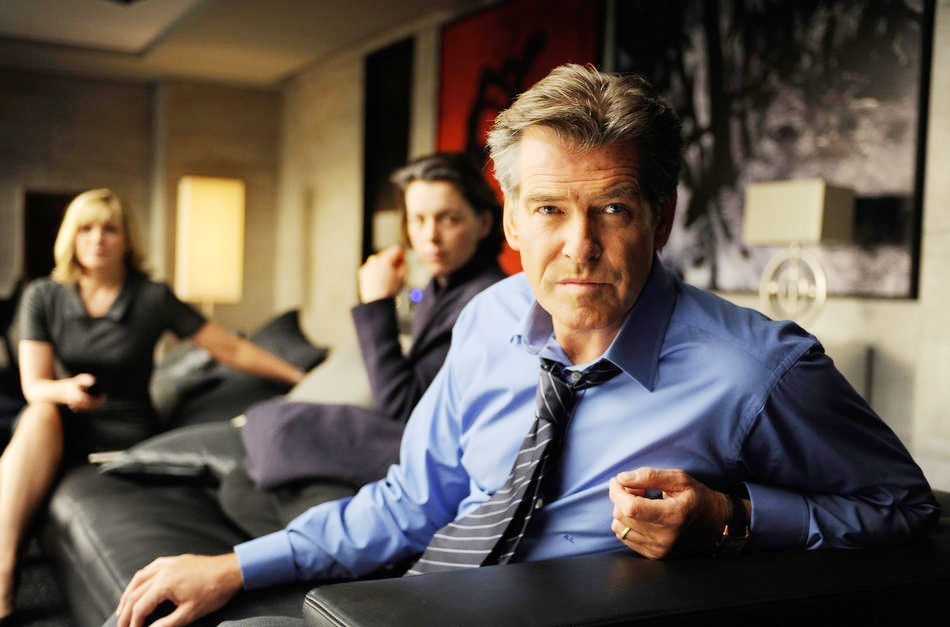
One cannot see this film without feeling that Polanski himself must have a few things in common with the former Prime Minister, well played by Pierce Brosnan; he's not really allowed to live anywhere he pleases unless he is willing to be held accountable for his supposed crime, and is generally hounded by the media, although lauded by his peers.
I haven't seen enough films by Polanski, but I know this one reminded me a lot of how "Chinatown" moved me, and I love that film. The script isn't as good here, but neither is it an action-packed film. It could easily have turned boring, but instead it turned up the pace half-way through. I loved some of the little things, like how we don't see the faces of some people, and how not all things are explained to us; like I previously wrote, this contributes to the feeling that Polanski treats his audience like thinking human beings.
The biggest put-down of the film was how much money a big automobile-builder must have spent as the film shows their latest navigational system a lot. Oh, drat.
Otherwise, I have only good things to say about this film. I'll watch it again in time, to catch up on some things I come to ponder on the second time around. Recommendable.