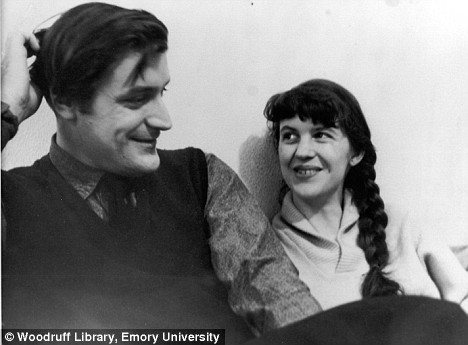
From pages 290-291 in "The Paris Review Interviews, vol. III", Ted Hughes speaks of how he's lost/destroyed/edited Sylvia Plath's last journals/poems and perhaps an entire novel. I'm suspicious of him as a whole, and it seems the world will never know the truth in its entirety.
INTERVIEWER
What happened to Plath's last novel that was never published?
Well, what I was aware of was a fragment of a novel, about seventy pages. Her mother said she saw a whole novel, but I never knew about it. What I was aware of was sixty, seventy pages that disappeared. And to tell you the truth, I always assumed her mother took them all on one of her visits.
INTERVIEWER
Would you talk about burning Plath's journals?
HUGHES
What I actually destroyed was one journal that covered maybe two or three months, the last months. And it was just sad. I just didn't want her children to see it, no. Particularly her last days.
INTERVIEWER
What about Ariel? Did you reorder the poems there?
HUGHES
Well, nobody in the United States wanted to publish the collection as , left it The one publisher over there who was interested wanted to cut it to twenty poems. The fear seemed to be that the whole lot might provoke some sort of backlash“”some revulsion. And at the time, you know, few magazine editors would publish the Ariel poems; few liked them. The qualities weren't so obvious in those days. So right from the start there was a question over just how the book was to be presented. I wanted the book that would display the whole range and variety. I remember writing to the man who suggested cutting it to twenty“”a longish intemperate letter, as I recall“”and saying I felt that was simply impossible. I was torn between cutting some things out and putting some more things in. I was keen to get some of the last poems in. But the real problem was, as I've said, that the U.S. publishers I approached did not want Sylvia's collection as it stood. Faber in England were happy to publish the book in any form. Finally it was a compromise“”I cut some things out and I put others in. As a result I have been mightily accused of disordering her intentions and even suppressing part of her work. But those charges have evolved twenty, thirty years after the event They are based on simple ignorance of how it all happened. Within six years of that first publication all her late poems were published in collections“”all 4at she'd put in her own Ariel and those she'd kept out. It was her growing fame, of course, that made it possible to publish them. And years ago, for anybody who was curious, I published the contents and order of her own typescript“”so if anybody wants to see what her Ariel was it's quite easy. On the other hand, how final was her order? She was forever shuffling the poems in her typescripts“”looking for different connections, better sequences. She knew there were always new possibilities, all fluid.