
Joseph Allen Maldonado-Passage, better known by his stage name Joe Exotic.
I read an article named Like pouring tequila on your brain: why Tiger King is the most-watched show on Netflix that created allure for me. It sounded like the people in that series are nuts. Completely off their rocks.
I saw the series and yawped. It's filled with rampant idiocy, weirdness, subjugated people, conniving and manipulative people, animal abuse, murder, cults, unintentional suicide, and kidnapping.
The memes came in. I must have seen all of them. I laughed. Crazy people.
We, the viewers, are so far from this. We just watch.
Right?
Netflix have created and distributed a series where a lot of things have gone wrong. The series does not point out a lot of the stuff that have been uncovered which do not border on the unethical side of making documentaries but crosses it without doubt or grey area.
The podcast Cat People highlighted some of the information in their fifth episode of the series:
Some of what's disclosed in that podcast episode:
- People were paid for interviews; this may influence perspectives and is never done in investigative journalism, which this series poses as being
- Joe Exotic lied about his brother's death
- One of the directors, Rebecca Chaiklin, says that John Finlay himself decided to lay shirtless throughout his interviews; he retorts by claiming this is untrue
- Carole Baskin is a complete and utter villain while Joe is painted more loosely
There is more in the podcast episode. One of the show's producers, Peter Frick-Wright, writes a lot of it [here](http://What Tiger King largely brushes aside is that Big Cat Rescue, on the other hand, only accepts animals confiscated by law enforcement or from owners who are trying to get rid of them. The series quickly skims over the fact that these cats are almost always adults and that the sanctuary forbids petting—if a staff member or volunteer touches an animal for any reason, they’re fired and never allowed to return. Finally, Big Cat Rescue will only take animals if the owners sign a contract declaring that they’ll never own, or even have a photo taken, with another big cat. If they violate the contract, there are financial penalties. The docuseries doesn’t mention this at all.). From that post:
What Tiger King largely brushes aside is that Big Cat Rescue, on the other hand, only accepts animals confiscated by law enforcement or from owners who are trying to get rid of them. The series quickly skims over the fact that these cats are almost always adults and that the sanctuary forbids petting—if a staff member or volunteer touches an animal for any reason, they’re fired and never allowed to return. Finally, Big Cat Rescue will only take animals if the owners sign a contract declaring that they’ll never own, or even have a photo taken, with another big cat. If they violate the contract, there are financial penalties. The docuseries doesn’t mention this at all.
Frick-Wright, P. (2020, April 9). ‘Tiger King’ Is A Wild Ride. And Largely Misleading. Outside Online. Retrieved May 6, 2020, from https://www.outsideonline.com/2411410/tiger-king-takedown-big-cat-industry
Netflix refused an interview request and some other people involved with the show said they 'couldn't' be interviewed for the podcast.
One of my favourite podcasts, Real Crime Profile, has heavy-hitting people on their show: Jim Clemente (former FBI profiler) and Laura Richards (ciminal behavioral analyst, former New Scotland Yard).
They have, so far, broadcast two episodes on Tiger King. I guess there will be more coming.
What I love most with Real Crime Profile is how the hosts break down what's wrong with things. When they covered Leaving Neverland, the documentary series about Michael Jackson's rape of young boys, they played some audio from the series. I'll never forget where Clemente stopped the tape where the director asks one of the interviewed adults who were raped by Jackson and said 'What did you do after you had sex?' and Clemente goes apeshit - rightly so - and says that 'sex' is not OK to use because it indicates that it's consensual and makes comparisons with other cases he's investigated where it's just a red flag that tells people a lot about people who use that word.
In talking about Tiger King, the hosts mostly tear it apart.
Richards believes the people who made Tiger King lost their way; Chaiklin says they, the filmmakers, wanted to understand the psychology behind the people, but the series is exploitative. Chaiklin has stated that she has 'a lot of empathy for Joe' and still speaks to him on the phone.
Exotic and some others in the series are described as 'colourful people' when they are actually manipulative and narcissistic. Exotic locked employees in their trailers, gave them expired meat (that Wal-Mart donated) to eat, extremely low pay, and threatened employees who wanted to leave Exotic with withholding pay.
As opposed to Cat People, Lisa Zambetti (co-host of Real Crime Profile and casting director for the TV-series Criminal Minds) claims that Exotic was displayed in a far more negative light than Baskin did, but I don't think Clemente agrees.
One thing that is not mentioned during the series is the fact that Exotic was raped at age five. It would have been massively interesting to hear.
Entrapment and coercive control is something that I feel is important to be aware of throughout the series, e.g. with Exotic being the boss of the men with whom he was married, plying them with drugs, and locking them into his compound. None of this was really contrasted or detailed in the TV series.
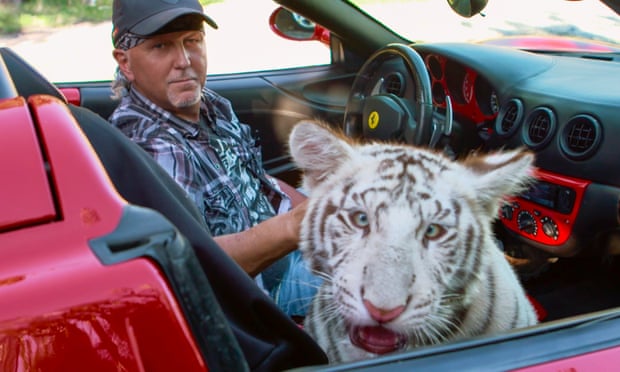
Jeff Lowe, nefarious person deluxe.
In a singular follow-up episode to Tiger King, the TV series, Jeff Lowe turns up and controls his wife on camera. To me, that was horrifying. To him, and perhaps to his wife, this may not be the case, but to all who have seen the TV series and are aware of how coercive control works, it's tragic to see. And it sits there, uncontested by Netflix or the exploitative host of that episode.
One of the Real Crime Profile hosts points out that the podcast named Joe Exotic: Tiger King is very interesting and shows a lot of facts that the TV series does not:
Real Crime Profile also go into how Exotic is a convicted of trying to kill somebody. He paid someone to kill Baskin. He showed how he would do that. He was very violent.
It's really interesting to hear them speak about this, contrasted by people who use #teamjoe and #teamcarol on social media, along with #freejoeexotic. This is just sad but only and truly speaks of the people who use them.
Exotic kept animals in tiny cages, didn't display compassion or empathy, and now he's a star, and that's what he wants.
Meanwhile, he's in a cage himself.
Sure, we can laugh at this story. We should look up facts from behind the scenes.
Joe was a prolific tiger and lion breeder, which he needed to be to support his tiger cub-petting business. And just as he bred animals, he killed them, as well. Moor’s podcast includes anecdotes about a steed named Miracle the Wonder Horse, which Joe secretly put down with a bullet, as well as the abuse and murder of many other animals.
“According to people who I talked to, he was killing animals in 2014,” Moor says, with the understanding that the killing likely happened long before then as well. “He was killing tigers to make room in cages. He was starving cats to death so he could feed them to snakes.”
Zakarin, J. (2020, April 9). What Netflix’s ‘Tiger King’ Left Out About Joe Exotic. Observer. Retrieved May 6, 2020, from https://observer.com/2020/04/netflix-tiger-king-joe-exotic-rob-moor-interview/
We should hold both Netflix and the documentary filmmakers to the fire about all of this, but probably mainly ourselves: what part do we, as viewers, play in all of this?